
Benefits of asphalt treatment
Financial Benefits: Material Savings and ETS Cost Reduction
Chemical neutralization and stabilization of reactive asphalt components directly translate into measurable financial benefits. By reducing the evaporation of volatile organic compounds (VOC) and light hydrocarbon fractions during high-temperature processes, valuable binder components are retained within the asphalt matrix instead of being lost to the atmosphere.
This material retention reduces effective binder consumption, limits mass losses during production and paving, and improves overall material efficiency. In parallel, lower VOC emissions reduce the amount of carbon released in gaseous form, contributing to a lower CO₂-equivalent footprint of asphalt production and application processes.
Where emissions accounting and lifecycle assessment (LCA) frameworks apply, this reduction supports lower exposure to carbon-related cost mechanisms, including ETS-type schemes, and strengthens cost predictability over the infrastructure lifecycle.
Operational Efficiency and Lifecycle Cost Reduction
Stabilization of chemically reactive asphalt components mitigates key degradation mechanisms accelerated by heat, oxygen and environmental exposure. As a result, asphalt mixtures exhibit improved resistance to aging, reduced susceptibility to rutting and surface abrasion, and more stable performance over time.
For infrastructure owners and operators, this translates into longer service life of pavements, extended maintenance intervals and fewer rehabilitation cycles. The cumulative effect is a reduction in total lifecycle costs, improved asset reliability and lower long-term budget volatility.
ESG Alignment: Measurable Environmental and Social Value
WESTRAND technologies support ESG objectives through direct, measurable process improvements rather than offset-based or declarative approaches. Environmental benefits result from limiting emissions at the source and improving material efficiency, reducing waste and uncontrolled release of hydrocarbons into the environment.
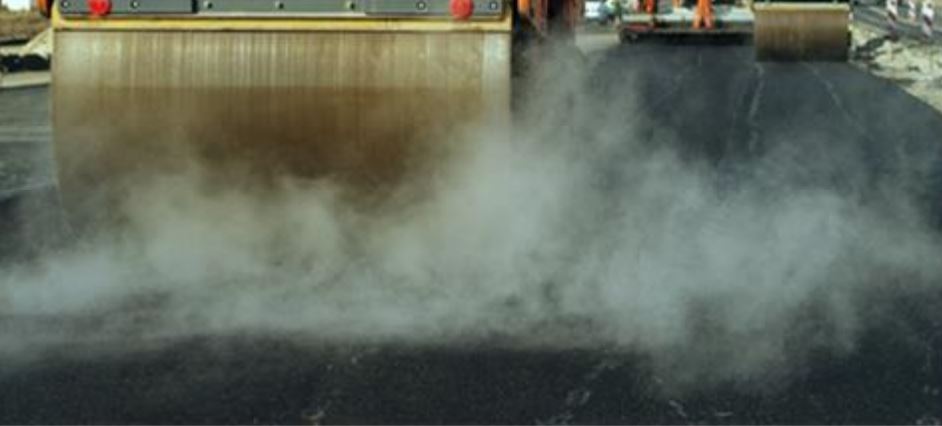
Social value is created by improving occupational safety conditions. Lower odor intensity and reduced toxicity of asphalt fumes decrease exposure risks for personnel during production and paving operations, supporting health and safety performance indicators.
Governance value is reinforced through transparency and auditability. Process effects—such as emission reduction, material retention and durability improvements—can be quantified, documented and integrated into ESG reporting frameworks.
Carbon Footprint Reduction through Process Stabilization
VOC emissions from hot asphalt represent a physical loss of carbon from the product in gaseous form. Chemical stabilization shifts this balance by binding reactive components within the asphalt structure, reducing volatilization under operational temperatures.
This mechanism leads to a measurable reduction in CO₂-equivalent emissions attributed to asphalt production and placement when assessed using lifecycle methodologies. The approach strengthens carbon footprint management strategies without requiring modifications to existing technological lines or logistics infrastructure.
No-Waste and Circular Asphalt Approach
By retaining valuable hydrocarbon fractions within the asphalt binder, chemical neutralization contributes to a more circular use of petrochemical resources. Instead of treating emissions as unavoidable losses, the technology reframes them as recoverable material value.
This approach aligns with modern circular-economy concepts in road construction and supports the transition toward low-loss, low-emission asphalt systems, particularly relevant in regions with high operating temperatures and large-scale infrastructure programs.
Integration without CAPEX Disruption
All solutions are designed for safe integration into existing downstream operations without the need for major capital investments or changes to production lines. Dedicated dosing systems ensure controlled application, repeatability and operational safety.
This minimizes implementation risk, preserves operational continuity and enables rapid validation under real production conditions.
From Pilot Validation to Industrial Scale
WESTRAND proposes a structured cooperation model based on joint validation, adaptation to local feedstocks and benchmarking under representative operating conditions. Pilot activities may include laboratory, semi-industrial and full operational tests to assess real-world effectiveness and support informed decisions regarding further deployment.
This approach ensures that performance claims are verified under local conditions and aligned with client-specific operational and regulatory requirements.
Executive FAQ
Does the technology require CAPEX-intensive modifications to existing installations?
No. The technology is designed for integration into existing downstream operations without the need for major capital investments. Implementation is based on dedicated dosing systems that can be installed with minimal disruption, preserving operational continuity and avoiding costly retrofits.
What is the primary source of economic value for the operator?
Economic value is generated through improved material efficiency, reduced binder losses during high-temperature operations, extended pavement service life and lower lifecycle maintenance costs. These effects combine to reduce total cost of ownership rather than shifting costs between process stages.
How does this technology reduce emissions without relying on offsets?
The approach limits emissions at the source by stabilizing reactive and volatile components within the asphalt matrix. Instead of compensating emissions externally, the technology prevents the physical loss of hydrocarbons into the atmosphere, enabling measurable and auditable reductions.
Is the technology compatible with ESG and post-IPO reporting requirements?
Yes. The effects of the technology—such as emission reduction, material retention, occupational safety improvement and durability enhancement—are quantifiable and auditable. This supports integration into ESG reporting frameworks and strengthens governance transparency expected from publicly accountable organizations.
What are the implementation risks?
Implementation risks are low due to the non-invasive nature of the solution. The technology does not interfere with core production processes and is validated through a structured pilot approach before full-scale deployment. This minimizes operational, technical and reputational risk.
Can the solution be adapted to local feedstocks and operating conditions?
Yes. Solutions are developed individually to account for local bitumen composition, additives, climate conditions and process temperatures. Adaptation is performed jointly with the client as part of pilot validation and benchmarking.
How is performance validated before scale-up?
Performance is validated through a staged approach including laboratory testing, semi-industrial trials and operational field tests. This ensures that results reflect real operating conditions and provide a reliable basis for investment and deployment decisions.
Does the technology impact occupational health and safety?
Yes. Reduced odor intensity and lower toxicity of asphalt fumes improve working conditions for personnel during production and paving operations. This contributes to improved health and safety indicators and reduced exposure-related risks.
How does this solution support long-term sustainability strategies?
By reducing waste, improving material efficiency and extending infrastructure service life, the technology supports circular-economy principles and long-term sustainability objectives. It enables operators to achieve measurable improvements without compromising operational efficiency or scalability.
Is this a product purchase or a partnership model?
WESTRAND proposes a partnership-oriented model focused on joint validation, adaptation and long-term performance optimization. The objective is not a one-time product sale, but sustainable value creation through cooperation and shared technical understanding.
Why should this technology be considered now?
Rising operational costs, increasing regulatory scrutiny and growing expectations related to ESG performance make material efficiency and emission control strategic priorities. Early adoption allows operators to reduce risk, gain operational insight and position themselves ahead of tightening requirements.